Dec 09, 2025
If you dive nitrox, sooner or later you will encounter the term Equivalent Air Depth, usually shortened to EAD. At first glance, it can seem like just another formula to memorize for a course exam. However, once you understand what EAD actually represents, it becomes one of the most useful planning tools in nitrox diving.
More importantly, EAD explains why nitrox works. Additionally, it shows how divers can safely extend no-decompression limits while still using familiar air tables. Therefore, understanding EAD is not optional knowledge. Instead, it is foundational to smart and disciplined nitrox diving.
Simply put, Equivalent Air Depth is a comparison tool.
Specifically, EAD is the depth at which breathing air would result in the same nitrogen uptake as breathing nitrox at your actual depth. Because nitrox contains more oxygen and, consequently, less nitrogen than air, your body absorbs nitrogen more slowly. As a result, even though you may be physically deeper, your nitrogen exposure behaves as if you were shallower.
In other words, EAD translates the nitrogen advantage of nitrox into a depth you already understand from air diving. Consequently, it allows you to plan nitrox dives using air-based decompression models.
The U.S. Navy Diving Manual formally defines EAD as the equivalent depth on air used for decompression planning when diving nitrogen-oxygen mixtures.
Understanding EAD matters for several reasons. First, it directly explains the increased no-decompression limits associated with nitrox. Second, it provides a structured and conservative way to plan dives. Finally, it reinforces safe boundaries when oxygen exposure becomes the limiting factor.
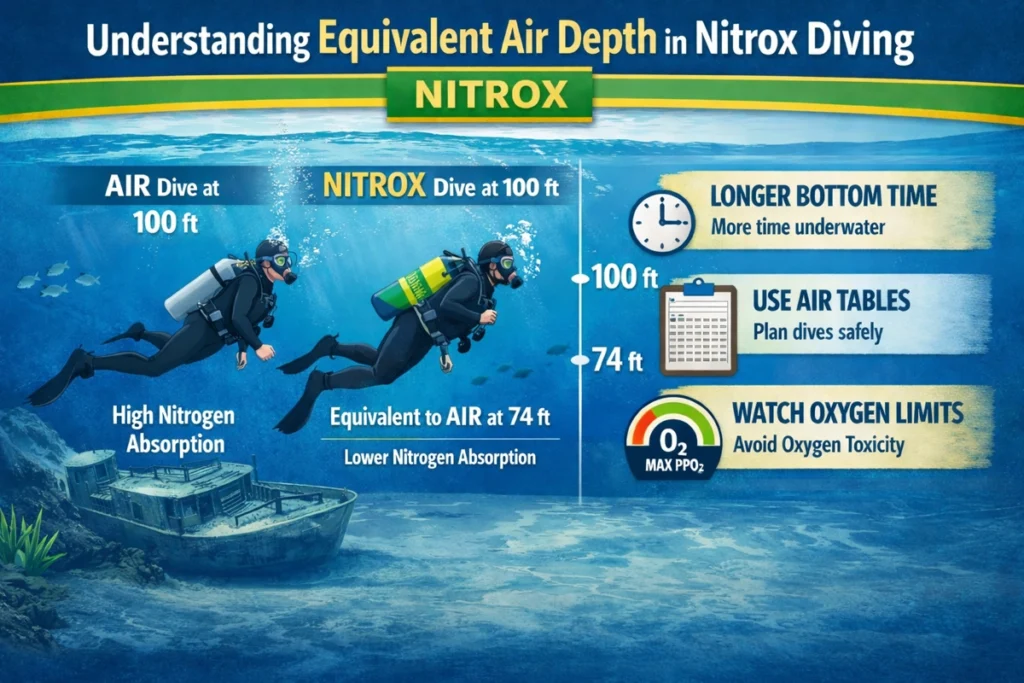
To begin with, reduced nitrogen uptake means slower tissue loading. Therefore, divers can remain at depth longer before reaching no-decompression limits.
For example, a diver using EAN36 at 105 feet absorbs nitrogen at roughly the same rate as an air diver at about 80 feet. Consequently, bottom time can increase significantly, sometimes even doubling under the right conditions.
At the same time, EAD allows divers to plan nitrox dives using standard air tables. As a result, many divers intentionally breathe nitrox while following air limits. By doing so, they create a meaningful safety buffer while still enjoying the reduced nitrogen exposure.
Thus, EAD becomes a practical tool not only for extending time but also for increasing conservatism.
However, EAD also reinforces discipline. While nitrogen exposure decreases, oxygen exposure increases. Therefore, EAD must always be used alongside maximum operating depth (MOD) and oxygen partial pressure limits. In this way, EAD helps balance benefit with risk rather than encouraging complacency.
As depth increases, ambient pressure rises. Consequently, nitrogen dissolves into body tissues more rapidly. However, when nitrogen is partially replaced by oxygen, there is simply less nitrogen available to be absorbed.
For comparison:
Therefore, nitrox slows nitrogen uptake at any given depth. EAD expresses this reduction by converting it into an “air-equivalent” depth.
Although dive computers handle this automatically, understanding the math remains valuable. Moreover, manual calculation reinforces why nitrox behaves the way it does.
EAD = (D + 33) × (1 − O₂%) / 0.79 − 33
Where:
Suppose you plan a dive to 70 feet using EAN40.
First, add surface pressure:
Next, determine nitrogen fraction:
Then, divide by air nitrogen fraction:
Finally, calculate EAD:
Therefore, even though you are diving to 70 feet, your nitrogen exposure is comparable to a 45-foot air dive.
Nevertheless, while manual calculations are useful for learning, they are not always convenient. For that reason, many divers rely on tools such as the Oceonatik EAD calculator.
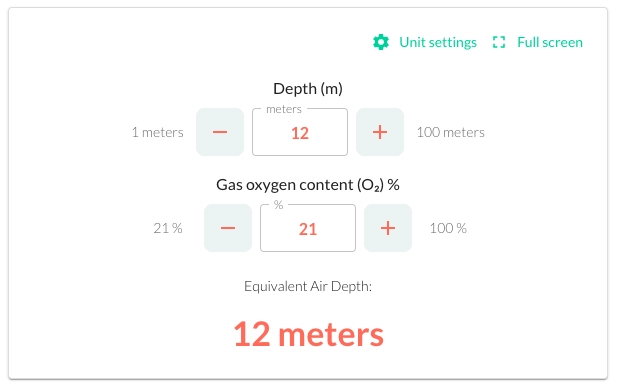
By using an online calculator, you can quickly convert depth and mix percentage into an accurate EAD. As a result, you minimize calculation errors, particularly when planning repetitive or multi-day dives. Moreover, this approach supports accurate nitrogen management and better adherence to dive tables. Consequently, it allows divers to focus on execution rather than arithmetic.
It is critical to remember that EAD only addresses nitrogen exposure. It does not account for oxygen toxicity.
As oxygen percentage increases, allowable depth decreases. Therefore, a dive can be well within nitrogen limits while still exceeding safe oxygen exposure. For this reason, EAD must always be used alongside MOD calculations and PPO₂ limits.
In short, EAD improves decompression safety, but oxygen limits still define absolute depth boundaries.
Ultimately, Equivalent Air Depth is the foundation of nitrox diving.
It explains why nitrox extends bottom time, shows how to safely use air tables, and provides a framework for conservative planning. More importantly, it shifts the diver’s mindset from chasing extra minutes to managing gas exposure intelligently.
Nitrox is simply a tool. However, EAD is what allows that tool to be used correctly, consistently, and safely.
